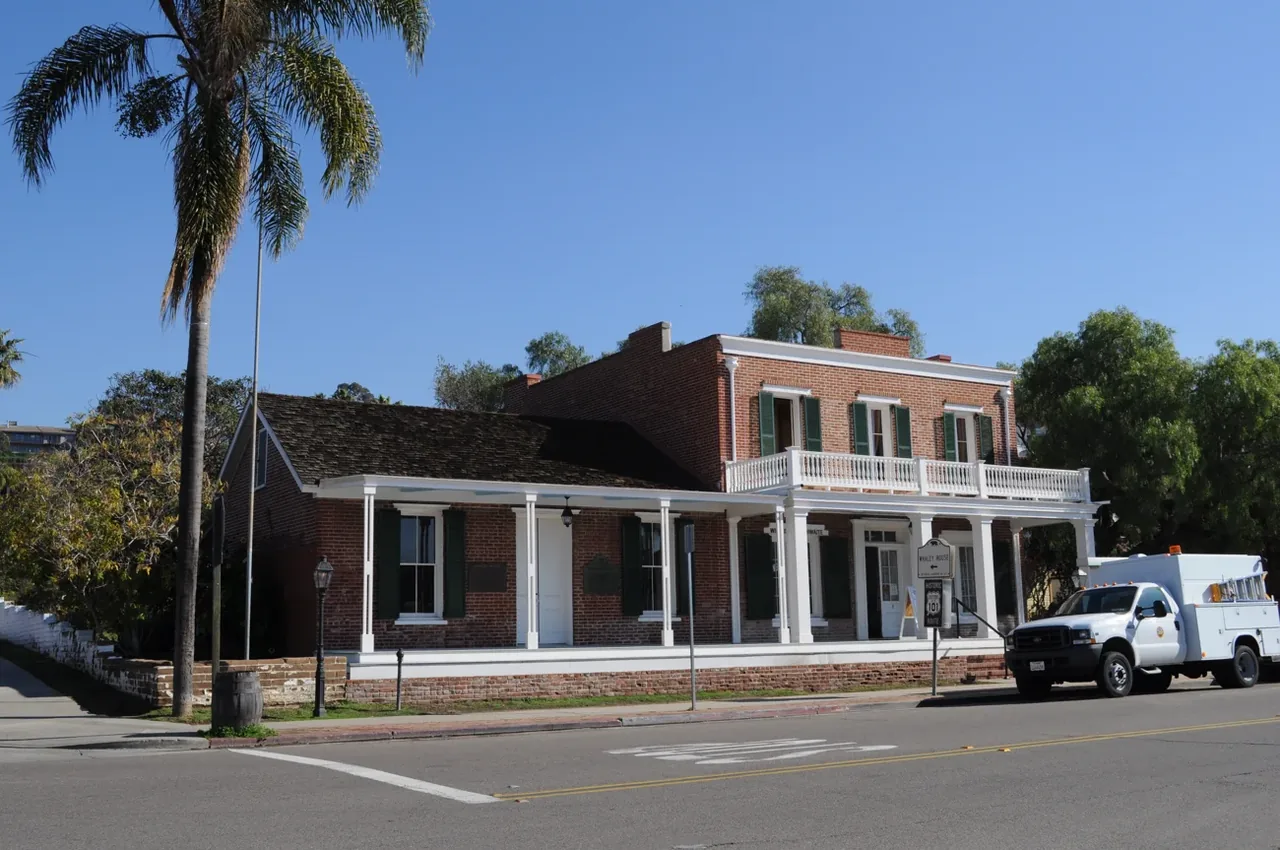
Completed in 1857, the Whaley House brings several chapters of Old Town San Diego into one brick building. Thomas Whaley designed the Greek Revival home and used bricks from his own brickyard. The County of San Diego identifies it as the city's first two-story brick building; it is also California Historical Landmark No. 65. [County history](https://www.sdparks.org/content/sdparks/en/park-pages/WhaleyHouse.html) · [Landmark record](https://ohp.parks.ca.gov/ListedResources/Detail/65)
The building was more than a family residence. Its rooms accommodated a general store, San Diego's first commercial theater in 1868, and the county courthouse. Whaley and Philip Crosthwaite opened their store here in 1869. Family loss also belongs to its documented history: Thomas and Anna's infant son died in 1858, and their daughter Violet died in 1885. These events are distinct from the house's later ghost traditions. [SOHO history](https://www.sohosandiego.org/educators/images/lessonspioneerwhaleyfamily.pdf)
Frank Whaley returned in 1909 to restore the aging building and show it to visitors. After a preservation campaign, the County purchased the house in 1956; the museum opened in May 1960. Today it remains a county-owned museum offering daytime self-guided visits and reserved evening guided tours. [Preservation history](https://www.sohosandiego.org/educators/images/lessonspioneerwhaleyfamily.pdf) · [Current tickets](https://www.whaleyhousesandiego.com/tickets/)
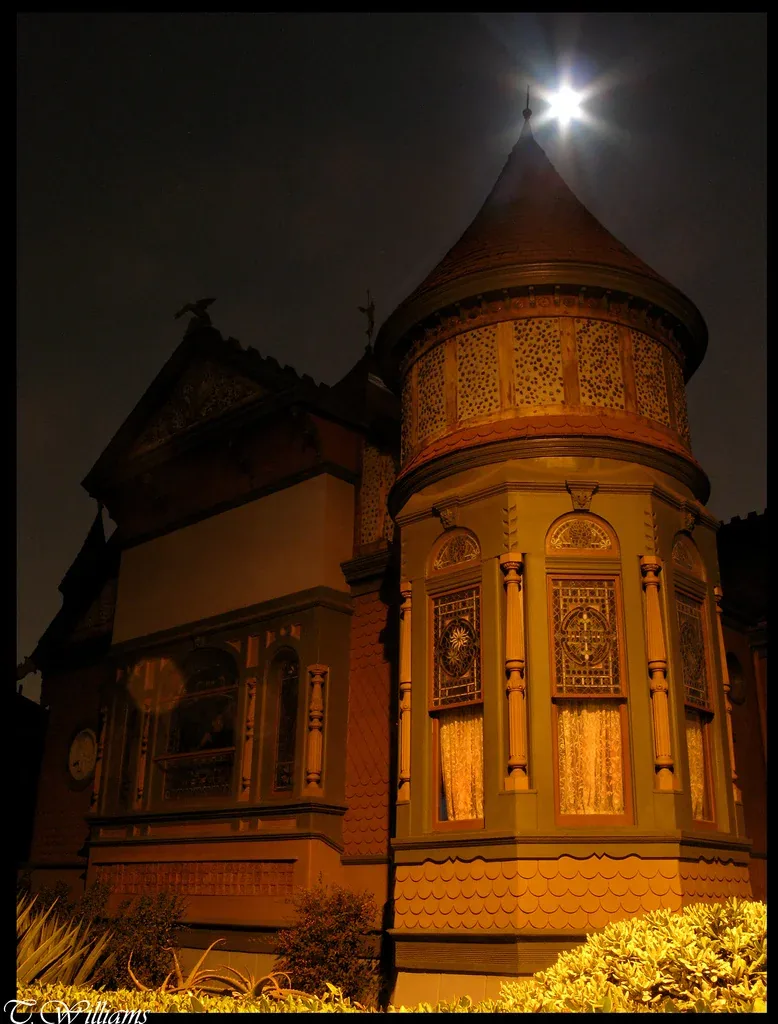
Villa Montezuma is an 1887 Queen Anne house museum in San Diego's Sherman Heights, built for pianist, vocalist and writer Jesse Shepard. Architects Comstock and Trotsche gave the house an elaborate Victorian design, with pictorial and patterned colored glass central to its character. Shepard later wrote under the name Francis Grierson; the [Historic American Buildings Survey](https://www.loc.gov/resource/hhh.ca0614.photos/?st=grid) records both careers and the building's architectural significance.
The house was more than a showpiece. Shepard hosted invited musical gatherings and developed his literary career here before selling the Villa in December 1889. Historian [Clare Crane's documented account](https://sandiegohistory.org/journal/1970/july/shepard/) also challenges sensational stories about his patrons and distinguishes his spiritual interests from claims that the house served as a séance business.
Preservation efforts saved the building in the 1960s, and it opened as a museum in November 1972. A 1986 fire led to restoration and reopening in 1987. Today the City owns the museum and the Friends of the Villa Montezuma operate it. The [operator's current guidance](https://villamontezumamuseum.org/) confirms guided weekend tours during ongoing restoration, with advance reservations. The grounds are not freely accessible, and interior photography is prohibited.
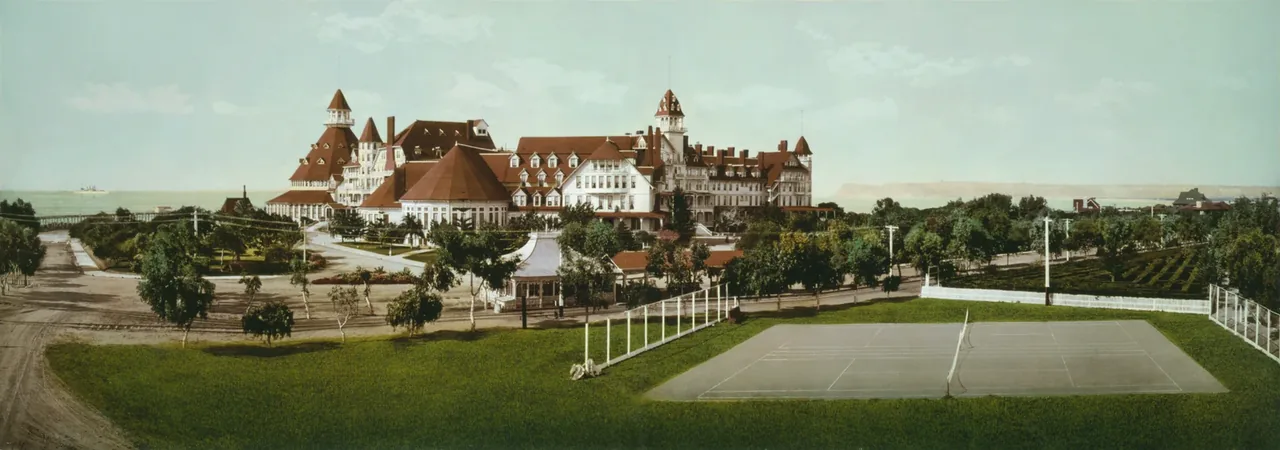
Hotel del Coronado is a surviving Victorian beach resort designed by James and Merritt Reid and completed in 1888. Its wooden Queen Anne architecture has endured successive alterations and restorations. California's Office of Historic Preservation records its state landmark designation in 1970, National Register listing in 1971 and National Historic Landmark designation in 1977. [State history](https://ohp.parks.ca.gov/?page_id=27425).
The hotel celebrates February 19, 1888 as its birthday because that was the first meal served in the main dining room; its own history notes that guests had already begun arriving in January. The same account identifies Kate Morgan as the guest who registered under the name Lottie A. Bernard and died at the hotel on November 29, 1892. It reports the county coroner's finding that her fatal injury was self-inflicted. [Hotel history](https://www.hoteldel.com/history/).
The building's story is also one of preservation. An extensive restoration reconstructed the original entrance veranda and recovered historic details, earning SOHO's 2022 Preservation Project of the Year award. Today it remains an operating resort that welcomes day visitors, with guest-room areas restricted to overnight guests. [Restoration](https://www.sohosandiego.org/pip2022/hoteldelcoronado.htm) · [Visitor policy](https://www.hoteldel.com/faq/).
Case file 013 · Circa 1860s; expanded in the 1890s
Newhall Ranch House, Heritage Junction
How obscureThe preservation move was independently reported in 1990; later television coverage concerns attributed ghost folklore rather than an established explanation of the 1916 death.
⌖ Santa Clarita, California
Haunted house & museumOpen to the publicGeneral area only
01Documented history
A ranch building with an uncertain beginning
The oldest part of the house is described as a small wood-frame structure over a brick cellar. The operator attributes its construction to Thomas R. Bard by tradition, rather than presenting a securely documented date. Henry Mayo Newhall acquired the ranch in 1875. The local archive places the larger front portion probably in 1893, while the current operator uses the broader 1890s. The house later served the ranch foreman's family and visiting company officials.
The archive's account identifies Margaret Routledge as the wife of Stanley Routledge, the Newhall Land and Farming Company's local ranch manager. Her surviving death record records a gunshot wound and states that suicide or accident could not be determined. The January 26 newspaper clipping reproduced alongside it has no identified newspaper title and contains errors in names. Its discussion of murder is an unresolved theory, not a finding. The cited accounts do not establish a murder or identify a perpetrator.
City grant funding helped the historical society move the house to Heritage Junction on the nights of August 14 and 15, 1990. Los Angeles Times reporter Steve Padilla covered the move that week, describing a two-story building cut into two sections and carried over two nights. Movers had to raise one load to clear a narrow bridge's retaining walls. The house reached the park safely and awaited its new foundation. Today's public historic campus is the preservation setting, not the scene's original geography.
The historical society relocated the house on the nights of August 14 and 15; contemporary Los Angeles Times reporting independently confirms the two-night move.
Folklore & reported experiences · not established facts
Folklore only: a 1990 Los Angeles Times report quoted a preservation volunteer saying the society had been told a ghost inhabited the house. Leon Worden's 2014 SCVNews account describes believers' stories of a 'blue lady' called Martha and a boy called Timothy, and the Travel Channel's Ghost Adventures episode about Heritage Junction. These are attributed ghost stories and television claims, not evidence of spirits, a murder, or a perpetrator.
04Visiting
Public viewing only
Checked November 17, 2026: the historical society's current home page lists the History Center grounds as open daily, 8 a.m.–5 p.m. It lists Saturday interior hours for the Saugus Train Station Museum, Edison House and Kingsburry House, but not the Newhall Ranch House. Treat this profile as an exterior visit during public grounds access; do not assume interior entry or arrange an unsanctioned investigation. Ask the operator about any separately announced access. William S. Hart's Ranch House and Hart Mansion are different buildings; their hours and appointments do not apply here. A duplicate footer on the visit page retains an older Tuesday–Sunday statement, so confirm the schedule before visiting. The retained map coordinate is a coarse area reference, not a verified building pin or directions.
Public viewing only. Do not enter buildings, locked sites, or old excavations without explicit authorized access.
For privacy and safety, the map shows the general area only. No exact pin, coordinates, or directions are provided by this map. Public museum visit details, where supplied, appear above.
Listing a place is not permission to enter private property or any closed building or cemetery. Many sites may be dangerous. Never trespass. Information may be incomplete or out of date.

 Haunted house & museum